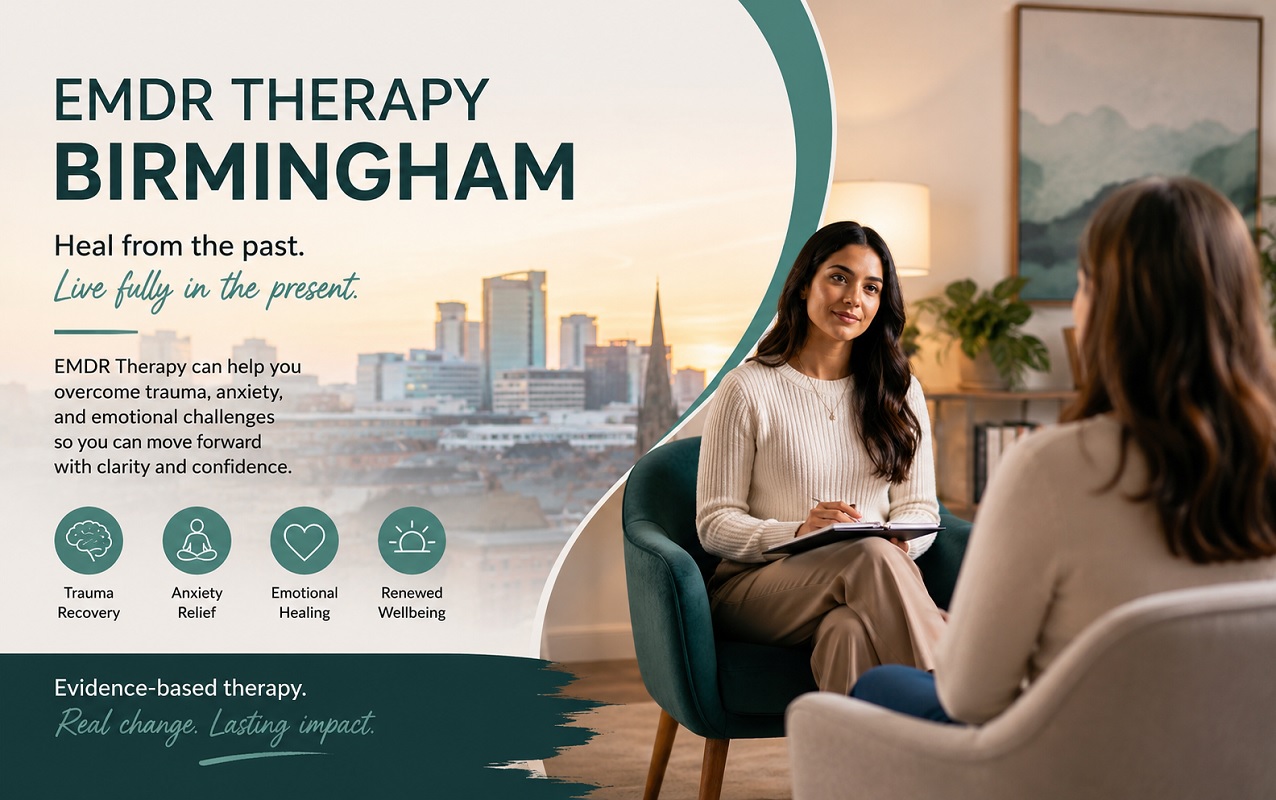
Why EMDR Therapy Birmingham Is Changing Lives in 2026
A New Era of Healing in Birmingham
Trauma leaves invisible wounds that traditional talking therapies sometimes struggle to reach. In recent years, a powerful and evidence-based approach has been quietly transforming mental health care across the UK. EMDR Therapy Birmingham has emerged as one of the most sought-after treatments for people who have carried the weight of trauma, anxiety, and distressing memories for far too long.
What was once considered a niche psychological intervention is now being recognised by the NHS, leading mental health charities, and thousands of patients as a genuine breakthrough in healing. Birmingham, as one of the UK’s most vibrant and diverse cities, is at the forefront of this movement — offering residents access to skilled EMDR practitioners who are changing lives every single week.
What Is EMDR and How Does It Work?
Eye Movement Desensitisation and Reprocessing — better known as EMDR — is a structured psychotherapy approach originally developed by Dr Francine Shapiro in the late 1980s. At its core, EMDR helps the brain reprocess traumatic memories that have become “stuck,” preventing them from causing ongoing emotional distress. During a session, a trained therapist guides the client through a series of bilateral stimulation techniques — most commonly side-to-side eye movements, though taps or tones may also be used — while the client holds a distressing memory in mind.
The theory behind EMDR draws on the brain’s natural ability to process and integrate experiences during REM sleep. Trauma disrupts this process, leaving memories stored in a raw, unprocessed state that continues to trigger fear, shame, and pain. Bilateral stimulation appears to “unlock” this processing, allowing the brain to file the memory away as something that happened in the past rather than something that is still happening now. Clients often describe a remarkable shift after just a few sessions — not that the memory disappears, but that it no longer holds the same emotional charge.
Who Can Benefit From EMDR Therapy?
EMDR was originally developed to treat Post-Traumatic Stress Disorder (PTSD), and it remains one of the most rigorously researched treatments for this condition. Both the World Health Organisation (WHO) and the National Institute for Health and Care Excellence (NICE) recommend EMDR as a first-line treatment for PTSD. However, its applications have expanded significantly over the past decade. Today, EMDR is used to treat a wide range of conditions including:
- Anxiety and panic disorders — including generalised anxiety, social anxiety, and phobias
- Depression — particularly where depressive episodes are rooted in past trauma or adverse life experiences
- Grief and loss — helping individuals process bereavement that has become complicated or prolonged
- Childhood trauma and abuse — including emotional, physical, and sexual abuse
- Complex PTSD (C-PTSD) — for those who have experienced repeated or prolonged traumatic events
- Performance anxiety — used by athletes, professionals, and public speakers to overcome mental blocks
- Low self-esteem and shame — addressing the negative core beliefs that often form in the wake of trauma
The versatility of EMDR is one of the reasons demand has surged across Birmingham and the wider West Midlands. People who had previously tried counselling, CBT, or medication without success are finding that EMDR reaches the parts of their experience that other therapies simply could not access.
The EMDR Therapy Process: What to Expect
Many people feel understandably nervous before beginning any form of psychological therapy. Understanding what EMDR actually involves can ease that anxiety considerably. A standard course of EMDR typically begins with one or two preparation sessions, during which the therapist takes a detailed history and helps the client develop coping strategies and grounding techniques. This preparation phase is crucial — it ensures clients feel safe and resourced before approaching difficult material.
Once the preparation is complete, the therapist and client identify specific target memories to work on. These targets are processed systematically using bilateral stimulation, and the therapist checks in regularly throughout the session to monitor progress. After each set of eye movements, clients are asked what comes to mind — images, emotions, body sensations, or thoughts — and the processing continues until the memory’s distress level drops significantly. Sessions are typically 60 to 90 minutes long, and most clients notice meaningful changes within six to twelve sessions, though complex cases may require more.
Why Birmingham Is the Right Place to Access EMDR
Birmingham is home to a growing community of highly qualified EMDR practitioners, many of whom have trained with EMDR UK & Ireland — the professional body that sets the standards for EMDR training and practice in this country. The city’s cultural diversity is also a significant advantage.
Trauma does not discriminate, and neither does EMDR Therapy Birmingham, with therapists offering services in multiple languages and with deep sensitivity to the cultural contexts that shape how trauma is experienced and expressed.
Whether you are a young professional dealing with work-related stress, a survivor of domestic abuse, a veteran managing combat-related PTSD, or a parent struggling with postnatal trauma, there is a skilled Birmingham-based EMDR therapist who understands your specific needs.
Accessibility has also improved dramatically. Many Birmingham EMDR therapists now offer online sessions alongside in-person appointments, making it easier than ever for people across the West Midlands to access quality trauma care without long travel times or waiting lists. Private practice waiting times in Birmingham are often considerably shorter than NHS referral pathways, which can be an important consideration when someone is in acute distress.
The Science behind the Results
Sceptics of EMDR sometimes question how moving your eyes while thinking about a traumatic memory could possibly produce therapeutic change. The answer lies in decades of neuroscientific research. Neuroimaging studies have shown that trauma fundamentally alters the way the brain stores and retrieves memories, particularly in regions like the amygdala, hippocampus, and prefrontal cortex. EMDR appears to reduce hyperactivity in the amygdala — the brain’s threat-detection centre — while restoring the prefrontal cortex’s ability to regulate emotional responses.
A landmark meta-analysis published in the Journal of Anxiety Disorders found that EMDR produced significant reductions in PTSD symptoms, often outperforming other established treatments including trauma-focused CBT in terms of speed of response. Clients frequently report that the changes feel different from those achieved through talking therapies — less intellectual, more embodied, and more lasting. The body, as well as the mind, seems to release the tension and vigilance that trauma creates.
Real Lives, Real Transformation
Behind every statistic is a human story. Across Birmingham, people are reclaiming their lives after years — sometimes decades — of living in the shadow of traumatic experience.
Former clients describe being able to sleep through the night for the first time in years, returning to work after long periods of absence, repairing relationships that trauma had strained, and rediscovering a sense of joy and safety that they feared was gone forever.
Parents report being more present and patient with their children. Professionals describe performing at levels they had not thought possible since their trauma occurred. These are not minor improvements — they are life-altering shifts.
Therapists practising EMDR in Birmingham consistently describe witnessing profound transformations in their clients. The work is emotionally demanding, but the results make it deeply rewarding. There is something uniquely powerful about watching someone walk out of a session carrying themselves differently — lighter, freer, and more connected to their own sense of self.
Taking the First Step towards Recovery
Reaching out for help is often the hardest part of the healing journey. Many people who would benefit enormously from EMDR spend months or even years hoping that the pain will simply fade on its own, or feeling that their experiences do not warrant professional support.
The truth is that trauma — however it originated — deserves to be taken seriously and treated with the most effective tools available. EMDR Therapy Birmingham offers exactly that: a compassionate, evidence-based, and highly effective path toward genuine healing.
If you or someone you love is struggling with the effects of trauma, anxiety, grief, or any of the conditions EMDR is known to treat, the most important thing you can do is make that first call or send that first email.
A brief initial consultation with a qualified EMDR therapist costs nothing in terms of commitment and could represent the beginning of a profound transformation. Birmingham has the practitioners, the expertise, and the compassion to support you — the only step left is yours to take.